Showing posts with label investing. Show all posts

Wednesday, December 7, 2011

Housing supply and demand - are we nearing equilibrium?

Is there any equilibrium point in housing market, considering the many factors influencing demand and supply?

The main determinants of the demand for housing are demographic. Population size and population growth are the core demographic variables. However, family size, the age composition of the family, the number of children, net migration, non-family household formation, the number of double family households, death rates, divorce rates, and marriages are other demographic variables that would influence demand for housing. Other factors such as household income, price of housing, cost, availability of credit, consumer preferences, investor preferences, price of substitutes and price of complements all play a role in determining demand for housing.

Income is an important determinant of demand as shown by a study conducted by De Leeuw in 1971 that showed positive income elasticity of demand in North America ranging from 0.5 to 0.9, meaning the market demand for housing grew as real income rose. The price of housing is also an important variable influencing demand for housing, where in terms of elasticity just like any normal goods it is negative increase in price will result in decrease in demand.

As for supply, the quantity of incoming supply is typically influenced by cost, price of existing stock of houses, and the technology used in the construction, where material costs tend to contribute the largest share of the construction cost, about 30% to 40%. In the short run, supply tends to be very price inelastic increase in cost will have less effect on supply. However, over a longer period, it tends to be very price elastic increase in cost will lower supply.

A study conducted by Fallis in 1985 showed price elasticity of supply was estimated at 8.2, indicating increased in cost would lower supply significantly. The degree of elasticity depends on the elasticity of substitution and supply restrictions. For example, the use of capital intensive technology has been employed to reduce the rising labour cost, thus having less impact on the supply of housing.

As at first half of 2011, Malaysia had 4,466,062 units of housing, an increase of 1.7% from the total of supply in the first half of 2010. About 24,709 units were completed in the first half of 2011, a lower number compared to 50,611 units completed in the first half of 2010. Kuala Lumpur and Selangor accounted for 6,567 units or 27% of the total new stock. Kuala Lumpur and Selangor had 414,436 and 1,285,192 homes, reflecting an increase of 2.0% and 1.7% respectively from the total as of first half of 2010.

Other states which showed significant number of units completed are Sarawak (2,612), Penang (2,507) and Perak (2,184). The incoming supply in the country was recorded at 560,636 units, where Selangor is the largest contributor (134,143 or 24% of the total) followed by Johor (76,429 or 14%) and Negri Sembilan (65,227). Kuala Lumpur has 39,656 units coming on stream.

In terms of transactions recorded as of first half of 2011 for the country, there were 133,984 transactions in the residential category, out of which the largest transacted numbers were priced in the range of RM100,000 to RM150,000, which accounted for 22,857 units, followed by units priced between RM250,000 and RM500,000, which accounted for 21,559 units.

Selangor recorded the highest number of transactions at 38,424 units, followed by Johor (15,015 units), Penang (13,832 units), and Kuala Lumpur (11,522 units). The most popular units transacted in Selangor, Kuala Lumpur, and Penang were for units priced between RM250,000 and RM500,000, while in Johor, the highest transactions recorded were for units priced between RM100,000 and RM150,000.

This brief analysis gives an indication that the total number of units coming into the market needs to be in line not only with the level of affordability of potential buyers in the area the projects are to be launched but also the demographics of Malaysian population.

As of July 2010, total population was estimated to be 28.25 million and the population is expected to grow at a rate of 2.4% per annum, where about 65% of the population is urban population. Today, less than 4% of Malaysians live in poverty and it is estimated that about 2.0% of the total urban population in Malaysia lives below the poverty line, earning monthly household income of equal or less than RM750. Low income households (earning income equal or less than RM2,000 per month) represents 75% of the median income in Malaysia.

The national average household income is estimated at RM4,000 per month. It should also be noted that about 65% of Malaysia's population is below the age of 35, thus there would definitely be strong demand for housing.

Due to continuous movement in the factors affecting supply and demand for housing, policy intervention is necessary to ensure that the majority of the population has equal access to own homes. Singapore's public housing policy is often cited as the most successful example of affordable housing provision in Asian cities. A study conducted in 2000 estimated that about 85% of the total population lived in public housing with nearly 95% of them owning the flats they occupied.

By centralising its public housing effort under a single authority, Housing Development Board, Singapore has circumvented the typical problems of duplication and fragmentation of duties, and bureaucratic rivalries associated with multi-agency implementation. This centralised function also serves as a mechanism to ensure supply and demand are checked.

It is hoped that the provision of affordable homes as announced in Budget 2012 would achieve its main objective of increasing home ownership among the majority of the population.

Senator Datuk Abdul Rahim Rahman is the executive chairman of Rahim & Co group of companies. - By Datuk Abdul Rahim Rahman (The Star)

Is Penang’s property growth sustainable?

We’ve just finished analyzing the results for the 3rd quarter Malaysian Housing Property Index (MHPI) property report (until September 2011), compiled by the National Property Information Center, NAPIC. Malaysian Housing Property Index is an index of all-house prices in Malaysia. These are reports available for public on a quarterly basis. All information is based on secondary or sub-sale residential property transactions, meaning, buying and selling of existing residential properties in Malaysia.

Register at www.aboutpropertyinvestment.com to know more.

We will be running a series articles to highlight the interesting findings that we’ve obtained from report. For your reference, the data will be taken in reference from year 2000 onwards until 3rd Quarter 2011. We will also do some data comparison with post 1998 periods.

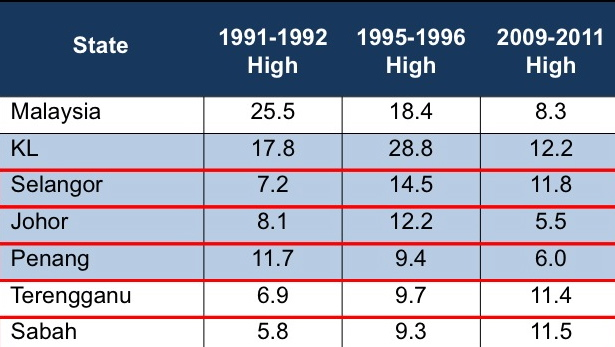
In this current article, we will be highlighting on Penang. In summary, it can be said that Penang, as a whole is experiencing a healthy property market, with prices increasing on an average of 6% for the period of 2009 to 2011. In comparison with the highs of 1995-1996 and 1992-1992, 6.0% capital appreciation is relatively low, and doesn’t show an unsustainable growth for the state of Penang.

Let’s look at Penang’s standing in the national standings, referencing the average house prices in the country. Looking at the statistics, Penang’s prices are at an average of RM232k. Comparing this with the national average of RM209k per unit, Penang is among the other states where property prices are higher than the national average.

One of the questions that arise from this analysis was the fact that Penang’s data takes both housing prices in the island state as well as the mainland properties.

The final chart we would like to highlight would be the property prices in Penang Island as compared to the mainland. Looking at the chart below, if you were to do a comparison study with regards to the prices, since 1999, until 3rd quarter 2011, you will notice that the appreciation of residential property prices have been significantly higher in the island state as compared to the mainland. Residential properties in the island state have seen a substantial growth exceeding 100%, since 2001.

We suspect that the figures could be higher, as the information pertaining to residential property growth doesn’t include statistics from primary market sales, or properties from developers.

In the next article, we’ll look more into the national statistics to measure if the current growth is sustainable or not.

For those of you who are interested to know more on our studies, we would like to invite you to our property talk, this coming Sunday, at Vistana Hotel, Penang.

For the first 17 people who sign up for the talk will receive one complimentary book from Ho Chin Soon. To register your seat, please visit www.aboutpropertyinvestment.com

By FREEMEN

FREEMEN is an organization that has been training investors since 2008 to benefit from any market and helped 200 individuals to invest in over RM30Million worth of properties, ALL with no money down! There will be a workshop this coming Sunday, 4th of Dec in Vistana Hotel, Penang entitled “How to achieve your financial freedom in 5 years of less” from 1:00pm till 6pm. Book early as we will be expecting a full house.

Wednesday, May 11, 2011

Top 5 Best Performing Public Mutual Fund in Year 2010

Great article for stock investors

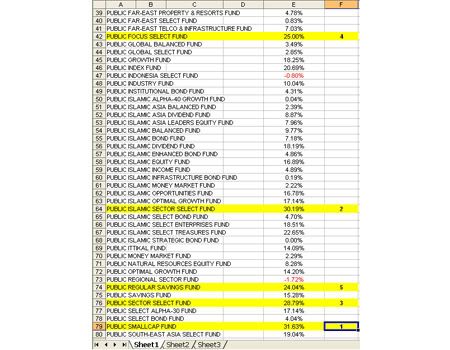
Are you Public Mutual Fund investor? Do you know which funds perform the best in year 2010? Now, I would like to share with you my personal analysis on Public Mutual Fund past performance from January - December 2010.

PublicMutualFundPerformance

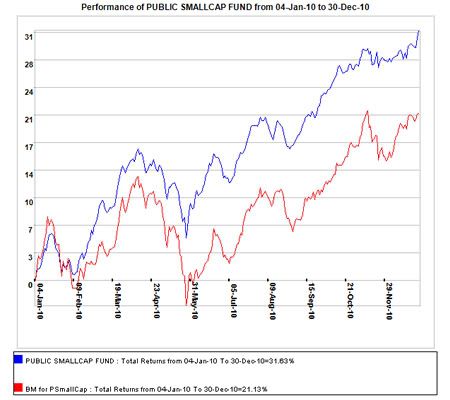
1. Public SmallCap Fund (PSMALLCAP)

Public Small Cap was the best performing fund in year 2010. We can see that the return last year was 31.63%.

PublicSmallCapFund

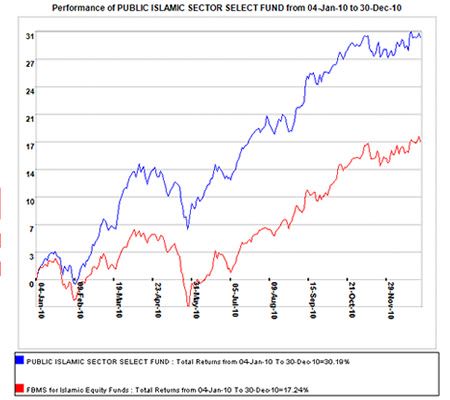
2. Public Islamic Sector Select Fund (PISSF)

Public Islamic Sector Select Fund (PISSF) was the best performing fund among all Islamic funds last year. It seeks to provide income by investing mainly in a portfolio of equities which complies with Shariah requirements from market sectors in the domestic market. The return was 30.19%

PublicIslamicSectorSelectFund

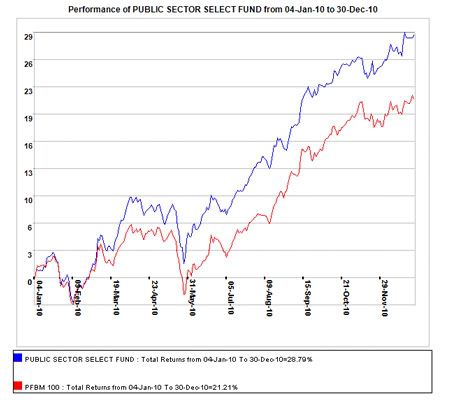
3. Public Sector Select Fund (PSSF)

Public Sector Select Fund (PSSF) ranked number in which it provided the return of 28.79%. I personally invest into this fund also as I feel that local market will boost in this year. Let’s wait and see!

PublicSectorSelectFund

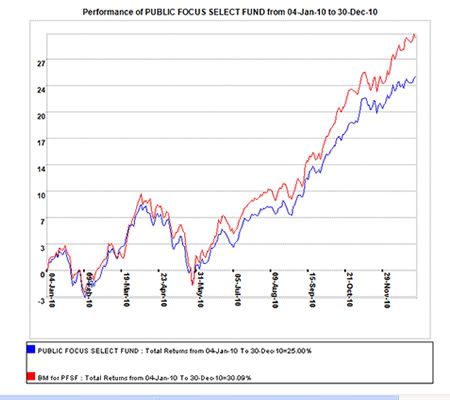
4. Public Focus Select Fund (PFSF)

Public Focus Select Fund (PFSF) is also my favorite fund. It may give the same positive result as Public Sector Select Fund if our local market performs really well. The return for last year was 25.00%

PublicFocusSelectFund

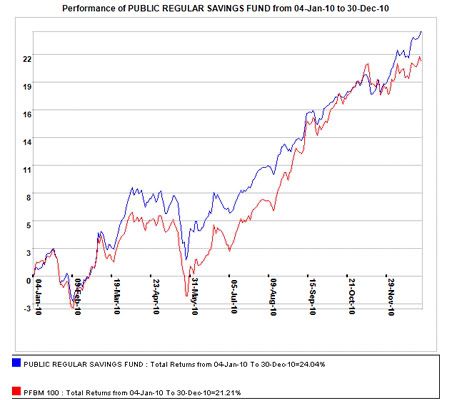
5. Public Regular Savings Fund (PRSF)

Public Regular Savings Fund is also another fund which generates more than 20% return last year. You can try to buy and hold this fund for long-term objective of capital growth.

PublicRegularSavingsFund

However, you should bear in mind that nobody can predict the future accurately. Investment is always a risky game. If you are an active investor, then buy more unit trusts to curb the inflation rate. Even if you choose to be a passive investor, you also can reap good return from unit trust investment by applying some simple strategies.

I will share more about my strategies in coming articles. Stay tuned and happy investing!

Thursday, January 6, 2011

Penang to become economic hub of the region

Sunday, 26 December 2010 20:03

THE FEDERAL government announced Penang is to become a regional economic hub through various projects and stimulus funds. Prime Minister Datuk Seri Najib Abdul Razak said the plans are in line with the government's aim of developing the Northern Corridor Economic Region.

"Ten major infrastructure projects have been identified, including expansions of the airport, Penang Port and Penang Bridge; construction of a second bridge; and the creation of a Multimedia Super Corridor in Penang," he said at the groundbreaking of Penang Airport's passenger terminal expansion. "These initiatives will not only facilitate economic activity, but also support our national objective to increase tourism revenue from RM53 billion in 2009 to RM168 billion by 2020." Read here and here.

Elaborating further, he said, “I believe Penang has unique advantages for it to become a hub for the Northern Corridor Economic Region (NCER) and Growth Triangle comprising Indonesia, Malaysia and Thailand." Read here.

In related news, Transport Minister Datuk Seri Kong Cho Ha said that cargo traffic for the Penang Airport has risen for the first eleven months of 2010, an increase of 12% over the same period the previous year. He added, "About 3,717,625 passengers used the terminal this year between January and Novermber placing the airport in fourth rank after the Kuala Lumpur International Airport, Kota Kinabalu and Kuching airports." Read here.

CapitaMalls buys Queensbay Mall

CapitaMalls Asia Limited announced that it will purchase Queensbay Mall, the largest mall in Penang, for RM658.3mil, or RM730 per square feet of net lettable land. This purchase makes Queensbay Mall CapitaMall's second mall in Penang, and fourth in Malaysia. Read here. "The acquisition of Queensbay Mall, the largest shopping mall in Penang, will substantially strengthen CapitaMalls Asia’s market leadership in the state," said CEO Lim Beng Chee. "This acquisition signals our ongoing commitment to invest in Malaysia’s retail sector for the long-term, following our listing of CapitaMalls Malaysia Trust in July this year.” Read here.

Other news

  • Four die in fire: A pre-dawn fire destroyed a two-storey shophouse in Jalan Perak, killing four members of a family. "The fire spread quickly as there were a lot of flammable items in the house, but we manage to put out the fire within 15 minutes," said Penang Fire and Rescue Department deputy director Mohd Razam Taja Rahim. Read here and here. Some say that the tragic incident should highlight the importance of a volunteer firefighting brigade, citing the efficiency of a volunteer unit based in Paya Terubong. Read here.
  • Waving goodbye to bad memories: To the thousands who drive by every day, enjoying the tranquil sight and the wind in their face, Pangsapuri Masjid Terapung is just another apartment complex by the sea. Read here.
  • Penang: 25 buildings, forest possible heritage sites: The National Heritage Department has identified 25 buildings and a forest in Penang for possible listing as national heritage sites, pending consent from private owners and the state government. Read here.
  • A lost era of music and harmony: Some 5,000 people recently converged under a starry Batu Ferringhi night sky for the Penang Island Jazz Festival, to find themselves being indulged with some of the most charming and idyllic live music to be heard on these shores for a while now. Read here.
  • Educate public on 3Rs, say plastic manufacturers: Educating the public on the importance of the 3Rs (recycle, reuse and reduce) should take top priority instead of implementing the "No free plastic bags" initiative, said the Malaysian Plastics Manufacturers Association (MPMA). Read here.
  • PMR: SMK Bukit Jambul is top in Penang: Sekolah Menengah Kebangsaan Bukit Jambul has emerged as the top school in Penang for the Penilaian Menengah Rendah (PMR) examination performance this year. Read here.
Credits to: http://www.igeorgetownpenang.com/

Thursday, December 9, 2010

Info: Real Property Gain Tax

RPGT

Chargeable persons

Every person whether or not resident in Malaysia is chargeable to RPGT in respect of any gains accruing on the disposal of real property in Malaysia

Rates of tax
Citizen & permanent residents

Category of disposal

Companies

Individuals

%

%

Disposal within 2 years

30

30

Disposal in 3rd year

20

20

Disposal in 4th year

15

15

Disposal in 5th year

5

5

Disposal in 6th year & subsequent years

5

NIL


Non citizen or non permanent resident

Category of disposal

%

Disposal within 5 years

30

Disposal in 6th year & subsequent years

5

1. The following are exempted from tax (for houses & other cases) :

· For individuals, the first RM5,000 or 10% of any chargeable gain whichever is greater.

· The gain on disposal by an individual who is a citizen or permanent resident of Malaysia of one private residence during his lifetime.

· The gain on compulsory acquisition under any written law. Gifts to governments, local authorities of charities.

· Real property transactions arising from mergers of financial institutions which were completed between 24 October 1998 and 20 June 1999.

ii. The following are treated as disposals at the original acquisition price so that no gain arises on the disposal (for houses & other cases) :

· Transfer by way of gift between husband and wife, parent and child and grandparent and grandchildren taking place within 5 years of acquisition.

· A transfer of real property to a company for a consideration consisting of shares or substantially of shares and the balance in cash.

· A transfer of real property to a company for a consideration consisting of shares or substantially of shares and the balance is cash.

· A transfer of assets between companies in the same group with the consent of the Director General of Inland Revenue.

Acquisition & Disposal of Chargeable Assets (Real Property)

Chargeable gain or allowable loss is the difference between the disposal price and the acquisition price on the disposal of a real property

1) Acquisition price includes:

Consideration per SPA

Plus
Incidental costs which include

  • Fees, commission or remuneration paid for professional services of surveyor, valuer, accountant, agent or legal adviser
  • Cost of transfer including stamp duty
  • Cost of advertising to find seller
  • Interest paid on capital employed to acquire the property where such a claim has not been made under income tax for rental income

Less:

  • compensation for damages to the asset
  • receipts under an insurance policy for damages to the property
  • deposits forfeited in respect of the property

2) Disposal price includes

Sale consideration

Less:
Incidental costs, which includes

  • Fees, commission or remuneration paid for professional services of surveyor, valuer, accountant, agent or legal adviser
  • Cost of transfer including stamp duty
  • Cost of advertising to find seller

Less:

  • Expenditure incurred on the asset at any time after its acquisition for the purpose of enhancing or preserving the value of asset ( includes renovations)
  • Expenditure incurred in establishing, preserving or defending the owner's title or a right over the asset

Administration

Form Filing

C.K.H.T. 1 Return of disposal of chargeable asset

To be filed within 1 month of date of disposal of chargeable asset

C.K.H.T. 2 Return of acquisition of chargeable asset

To be filed within 1 month of date of acquisition of chargeable asset

Info on Stamp Duty chargers/ rates for Property

Stamp duty is one of the method our government earns revenue.

When a property is transacted, stamp duty is imposed on the following manners:

1) When A Property Is Rented.

The tenancy is stamped with an amount calculated as follow:-

a) Firstly, calculate the annual rent (eg: RM600 per month x 12 months = RM7,200).

b) Then less RM2,400 from the annual rent (eg. RM7,200 - 2,400). This is because the first RM2,400 is exempted from stamp duty which means that rent per month of RM200 need not pay stamp duty.

c) Next, calculate the stamp duty payable based on the following table:-


When the lease is for a period:-


1 year or less

More than 1 year but equal to 3 years or less than 3 years

Exceeding 3 years or more

For every RM250 or part thereof in excess of RM2,400

RM1

RM2

RM4

d) For every copy of the tenancy agreement a stamp duty of RM10 is chargeable.

2) When A Property Is Sold.

All transfers of property attract stamp duty regardless whether the acquirer gives consideration (value in money or kind example by exchange, as gifts from loves one) for the transfer or not.

The Malaysian government at times impose stamp duty exemption for certain property type for a certain period of time so as to encourage housing sale. Currently, no exemption is given.

Stamp duty for transfer of property is chargeable at the following rate:


Value Of Property

Rate Of Stamp Duty %

Up to RM100,000

1

RM100,001 to RM500,000

2

RM500,001 onwards

3

3) When A Property Is Mortgaged

When a property is mortgaged, mostly likely the lender of the money will claim charge over the property, the lender does this by creating a Charge on the property. Hence, a Charge is an instrument created by statute namely the National Land Code (NLC). A Charge enable the Chargee (lender) a security for the loan granted to the Chargor (Borrower) over the property charged.

Stamp duty is calculated at the rate of about 0.5%.

Thursday, May 27, 2010

TK Residence perspective

Dear Friends,

Here are some perspective of the TK Residence project.

Our soft launch would be somewhere in July at the new Anson Road office
(Opposite KDU College Penang)

As said earlier on, the price hasn't been determined yet, but stay tune to our latest updates!


Thanks, and more updates soon!

Tuesday, May 11, 2010

Casa Perdana (New Homes for Home Searches and Investors)


Casa Perdana - 3 storey terrace homes

Casa Perdana, an exclusive and freehold property scheme ideally located at Seberang Prai Tengah is ready to expand its site after the successful launch of Phase 1 with the newly launch of Phase 2 this coming June 2010.

Phase 2 of Casa Perdana is a project that consists of 44 units (in total) of 3 storey terrace (20’ x 60’) placed on a 6.5 acre land. Each home offers a spacious area of 2,300+ square feet (built up) for families to live in. This project is posed to bless its residence with the enjoyment of nature’s flora and fauna right at their doorstep.

Attractive features that new home buyers will definitely be interested in, is the new improved quality specs offered as well as the high quality finishing that the developer would be providing. (Please find the details mentioned at the “specifications” area of the brochure/ internet website) All houses are also set to be elegantly designed to suite your modern family needs.

Families will find comfort as their new home will come with 4 bedrooms and 4 bathrooms with high ceilings, designed to provide the need for comfort, relaxation and space. Families would also find easy convenience the project is close to public amenities such as shopping malls, hypermarket, hospitals, schools and banks. The site is also easily accessible from Penang Island & other major towns.

Land area: 20’ x 60’ (1,200 sq.ft)

Build up area: 2,373 sq.ft

  1. 2,373 sq.ft built up area with 4+1 bedrooms, 4 bathrooms and spacious balcony
  2. All houses are elegantly designed with improved quality spec & high quality finishes to suite modern lifestyle living
  3. 12’ high ceiling on ground floor & 11’ high ceiling on 1st/2nd floor for better air ventilation
  4. Covered car porch can accommodate 2 cars
  5. Under construction, expected to be completed in 2011
  6. Houses are made with distinctive quality finishes, such as light tinted glass, powder coated fixtures & branded fittings
  7. Exclusive & FREEHOLD with individual title
  8. Phase 1 Completed and Sold Out in 2007 – Currently fully occupied
  9. Surrounded by matured housing estate & well developed infrastructures.

Location

  1. Ideally located at Seberang Prai Tengah, one of the fastes growing township in Prai
  2. Close to public amenities such as shopping malls, hypermarket, hospitals, schools and banks.
  3. Easily accessible from Penang Island & other major towns. Only 4 minutes from Penang Bridge, 5 minutes from Juru Auto City & Bukit Mertajam town.
Summary

Project: Casa Perdana
Type: 3 Storey Terrace Homes
Tenure: Freehold
Location: Seberang Prai Tengah
Land Area: Approximately 1,200 sq.ft. (20' 60')
Built up Area: Approximately 2,373 sq.ft.
Convenience: 1. Ideally located in one of the fastest township in Prai
2. Close to Shopping Malls, Hypermarkets, Hospital, Schools and Banks
3. Easily accessible from Penang Island and other major towns
4. 4 mins away from from Penang Bridge
5. 5 mins away from Juru Auto City and Bukit Mertajam
Expected Completion: 2011

We have updated lots of info on this project. To view more, please click here!

For
more information don't hesitate to call us.
Carey Real Estate (Pg) Sdn. Bhd.
04 - 2106366
Sales and Marketing Team: Michael /Ryan / Charmine / Daniel /
Kelvin Ng / Kelvin Lim

.:Interesting Sites:.