Tuesday, April 12, 2011

No reduction in property launches

SHOULD there be any softening of the broad property market, one of the first segments that may soften will be the high-end segment of the condominium market. The landed housing segment is still seeing strong demand, particularly in the Klang Valley and Penang, says OCBC Bank (Malaysia) Bhd country chief risk officer Choo Yee Kwan.


Choo Yee Kwan ... ‘The landed housing segment is still seeing strong demand.'

“For the residential segment, no clear signs of any softening have been observed. As the broad property market' would cover commercial properties, we have observed that the applications for the financing of commercial properties have held up in March 2011,” Choo says in an e-mail.

He says the indication is that there will be an increase in housing loan applications in March this year, higher than the comparative volumes they saw during the preceding first two months of the year.

It was reported earlier that housing loan application totalled RM12.56bil in January and RM10.26bil in February, which prompted questions whether the drop in application will lead to a slowdown in the property sector.

Choo says the drop in housing applications from November to Febuary is not conclusive as the period was also subject to seasonal trends relating to the year-end holiday period and festive season during the beginning of the year. Typically, volumes tend to be lower during this period.

“It is useful to note that there has, indeed, been no reduction in housing launches since the beginning of this year, and that the take-up rate has been good, particularly of landed properties in the more affordable price ranges. New launches for both landed property and condominiums (particularly those in the affordable price ranges) are still being well received.

“However, for the high-end segment of the condominium market, there have been comparatively fewer launches which can also suggest that the demand for luxury high-rise units has somewhat waned.

“The bottom-line is that we still need to observe developments over a longer period before making any conclusive assertions in respect of this matter,” he says.

Choo says generally, the bank has observed that the loan quantum has been steadily increasing in line with upward price movements of residential properties, notably in the key areas of urban concentration such as the Klang Valley and Penang.

One of the factors that can affect the selling prices of houses is the underlying cost of the core building materials like cement, steel and timber.

By The Star (by Thean Lee Cheng)

Long-term vision necessary in planning future cities

KLANG Valley folks are known for their ability to cope with heavily congested roads but even they are growing edgy these days as many public facilities are increasingly becoming inadequate and overstretched.

From the widely-publicised overcrowded buses, trains and other modes of public transport, parks, roads, public housing and recreational facilities are also over-stretched and need to be upgraded and expanded.

It is important to ensure there are adequate space provided for more public facilities to promote a higher quality of life for the people.

The level of livability of our towns and cities is to a large extent dependent on the overall environment and the adequacy and quality of public facilities provided for the people.

In planning for the Greater Kuala Lumpur (GKL) conurbation, it is imperative for our planners to benchmark against other global cities around the world and learn from them why these cities have become such great metropolis.

As the GKL covers quite a massive geographical area, together with the government land to be opened up for redevelopment, much can be done to improve things for Klang Valley folks.

The master planning for GKL should strive for a sustainable global city that takes into account the fast expanding population.

Development plans for housing, commercial facilities, schools, universities, hospitals and other infrastructure facilities should be able to cope with the expanding needs over at least the next 20 to 30 years.

Meanwhile, there should not be too much emphasis on maximising land use and plot ratio in property projects as this will lead to over high density developments and over crowding. Instead there should be a healthy balance between the built and unbuilt environment, and it is important to allocate land for public parks and other wholesome recreational facilities.

Although it is heartening to note that planning for a more efficient and better integrated public transport infrastructure for the GKL is underway, these facilities should be synchronised and be integrated with plans for other public facilities including new property developments.

The MRT factor

We can learn from Singapore how its mass rapid transit system (MRT) is planned holistically and meticulously to integrate with all the public housing apartments provided by the Housing Development Board (HDB).

Every MRT station in the city state is within walking distance to the nearby HDB housing precincts and shopping complexes. Commuters can safely walk along paved pedestrian walkways to the stations.

As the planning for the GKL's MRT infrastructure is still in the early days, the master planners should pay utmost importance to ensure the system can become a beacon for the greening of our cities. With proper planning, less people will need to drive around and there will be less road congestion and pollution.

Many Malaysians believe that one of the main factors contributing to the severe overstretched public facilities can be traced to the influx of too many foreign unskilled people, especially those who are here illegally.

Proper enforcement is necessary to ensure all the foreign workers in the country are here legally and are duly employed and properly supervised to prevent them from getting involved in undesirable activities.

Besides stretching our public resources to the limit, there are also social problems that are associated with the big number of foreigners, especially illegal immigrants, in our midst. These include the increasing number of illegal foreign colonies or settlements, and other accompanying problems like outbreaks of diseases.

It may be unfair to link crime to the immigrant population, but the fact is many people are uneasy when such settlements spring up near our housing estates.

Often, for peace of mind, people have no choice but to resort to surveillance measures such as fencing up their housing estates and employing 24-hour security guards.

The rising number of housing estates that are been fenced up and guarded this way, shows that this is a significant problem and more concrete actions need to be undertaken to return peace and security to our housing estates.

Deputy news editor Angie Ng believes that in the pursuit of growth and development, the spirit and values of the individual should not be compromised.

By The Star (by Angie Ng)

Will PBBank Share Price Go Further Up?

No one can foresee the future, it’s right that you may sustain a gain of more than 50% of annual return for now, but it may not last when the market crash and your share drop back to where it was before, then your 50% of annual return turn out to be 0% gain. So, if you are good investor, then you should know:

i) Right price to buy

ii) Right price to sell

iii) When to buy

iv) When to sell

All these criteria above is to ensure that you can achieve what you expected.

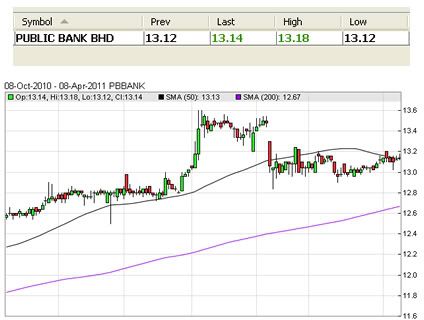
Today, I have interested in PBBank counter. In my opinion PBBank is a very good stock to hold. No matter what is the entry price, after many years of growth still can sustain above 20% return on investment, it’s proven by the historical share price which is steadily increasing.

PBBank

If you look at the price on the chart, the price of PBBank was a peak, right? In my opinion if they still sustain growth, I don’t see why not they can’t stay above RM14.

By the way, even the price dropped to about RM7 in year 2008, now it has been going up even higher than before. However, if you looking for long term profit, then you can try this stock as you won’t bother much about daily price movement. Else, you will have wrong judgment when your emotion affected by the market sentiment and movement.

HK 'Superman' Ka-shing ahead in malls bid

Kuala Lumpur: The Cheung Kong Group, owned by Hong Kong tycoon Li Ka-shing, has emerged as the front runner to buy three shopping complexes put up for sale by TMW Asia Property Fund.


Cheung Kong, which also helps manage AmFirst REIT in Malaysia via its affiliate ARA, is said to be going through the books of Ipoh Parade in Perak, Klang Parade in Selangor and Seremban Parade in Negri Sembilan.

Sources told Business Times that Cheong Kong was selected after its offer thumped those made by two other listed companies.

However, it is unclear if Cheung Kong (Holdings) Ltd made the bid directly or through one of the funds affiliated to it.

Li, who is also Asia's richest man, is known as "Superman" in Hong Kong due to his deal-making ability. His Cheung Kong conglomerate is one of Hong Kong's biggest property developers and owns the world's largest operator of container ports, among others.

German-based TMW Asia Property Fund is selling the three shopping complexes which it bought in 2005 in a tender. The tender closed on March 8 2011.

The fund is managed by Pramerica, the real estate investment management business of Prudential Inc from the US.

It is understood that the asking price for the three assets was set at RM500 million.

International property consultant Rahim & Co was appointed as the exclusive agent to handle the tender.

Real estate agent, Rahim & Co's managing director Robert Ang, when contacted by Business Times to confirm the bidders declined to comment.

TMW Asia bought the properties which then belonged to the Lion Group for RM340 million.

According to previous reports, Seremban Parade has a nett lettable area of 316,847 sq ft and sits on 1.97ha, Ipoh Parade has a nett lettable area of 594,414 sq ft on 4.14ha and Klang Parade has 696,045 sq ft of space.

Cheung Kong's affiliate, ARA Asia Dragon Fund, bought two properties in Malaysia last year - One Mont' Kiara in Kuala Lumpur and Aeon Bandaraya Mall Melaka - for a total of RM710 million.

By Business Times

W Hotel makes its mark in KL


It’s official: (From left) Rohana, Dijaya Corporation Berhad deputy managing director Dickson Tan, Dijaya Corporation group chief executive officer Tan Sri Danny Tan, Ng, Abbott, Starwood Asia Pacific development director Rajit Sukumaran and Dijaya Corporation Berhad managing director Datuk Tong Kien Onn at the signing ceremony to develop W KL.

A 150-room hotel will be built in the heart of Kuala Lumpur offering guests a unique dining experience, entertainment and signature spas.

Property developer Dijaya Corporation Berhad has partnered hotel and leisure company Starwood Hotels & Resorts Worldwide Inc to develop W Hotel. The brand has 41 hotels worldwide.

The signing ceremony was held at the Tropicana Golf and Country Club recently.

Tourism Minister Datuk Seri Dr Ng Yen Yen, who attended the event, said the collaboration of the two major brands in the leisure industry to bring in the W brand to Malaysia would boost tourism.

“Although ranking fifth in terms of contribution towards the economy, the tourism industry in Malaysia is growing. Hotel occupancy last year was 66.9% which is a 4.2% increase compared with 2009.

“Looking at this increasing rate, we will still be short of 40,000 rooms in 2020. We welcome every addition and are convinced that W KL will inject a design-led lifestyle in our city,” she said.

Dijaya independent non-executive chairman Datuk Rohana Mahmood said the move underlined the company’s commitment to continued growth.

“Dijaya is looking at the needs of tomorrow’s jet-setters while also addressing a wider range of environmental challenges facing the industry,” said Rohana, adding that Dijaya will also work towards a Green Building Index rating with W KL.

Starwood Asia Pacific regional vice-president (South East Asia) Chuck Abbott said they were delighted with the signing of the W brand in Kuala Lumpur as the city was cosmopolitan a business hub.

“Malaysia has developed a reputation for its standard of hospitality and customer service and we are proud to contribute to the continuing growth of Malaysia as a key business and leisure destination,” he said.

The hotel will feature 1,200 sq m of meeting space, one ballroom and five meeting and function rooms. All guest rooms will be fitted with the signature W Bed. Among the facilities are a fitness centre, food and beverage outlets, a full service spa and a nail bar.

W KL will be located in the Golden Triangle in Jalan Ampang.

By The Star

.:Interesting Sites:.